Spacer
Product Survey
Product Survey > Deep-water Swathe Bathymetry Systems
Deep-water Swathe Bathymetry Systems

Following on presentation of shallow-water multi-beam systems in our December 2006 issue, this product survey focuses on deep-water multi-beam systems. You may have noticed that the previous survey did not fully cover the available systems. Details of GeoSwath Plus, L3 Seabeam 1185, Reson Seabat systems, and Kongsberg 3000 and 3002 are thus included in the present survey. Although most of the systems covered here may be classified as ‘multi-beam’, in fact this designation is not correct; taking into account the sonar methods employed they should actually be classified as ‘swathe bathymetry systems’. Traditional multi-beam systems still make up the majority of those presently used in the field using multi-beam sonar methods. However, phase-measurement systems like the GeoAcoustics GeoSwath Plus and those using a combination of amplitude and phase measurement have proved their advantages over the traditional multi-beam system.

Users nowadays understand ‘deep water’ to refer to depths exceeding 1,000m. Multi-beam systems designed for ranges greater than 300-500m we here consider ‘deepwater’ systems. They operate at lower frequency, ranging from five to 80kHz. A further growth in demand for deepwater marine survey has been noted, especially in the oil & gas industry and oceanographic research. The need for higher resolution and more reliable data has led most manufacturers to improve specifications and introduce new versions of their systems.

Since our last product survey on deepwater multibeam systems in 2003 we have also noticed a growth in demand for multi-beam/swathe bathymetry systems for AUV/UUV applications. Where further range extension becomes technically difficult to achieve, systems are being integrated into ROV/AUV/UUV vehicles, allowing the systems to descend to required depths and so attaining ‘deepwater’ capabilities.


Participating suppliers:

  • Atlas Hydrographic
  • GeoAcoustics
  • Kongsberg Maritime
  • L-3 Communications ELAC Nautik GmbH
  • Reson
Icon PDF Download Deep-water Swathe Bathymetry Systems
© HYDRO International
Most Popular Articles Most Popular News Most Popular Jobs
Spacer
 

Interactive


Hydrographic Survey of Riverbed Erosion

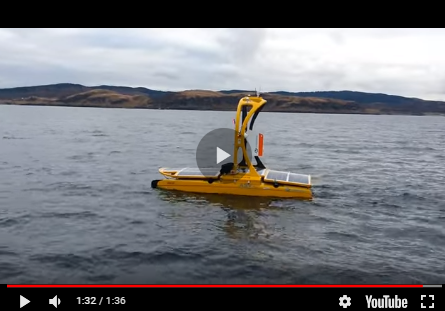
Members of the US Geological Survey were filmed while out on the Missouri River at Williston, North Dakota, USA, performing a hydrographic survey to monitor the state of riverbed erosion. They were using a multibeam echo sounder which transmits sound energy and analyses the return signal (echo) that has bounced off the riverbed or other objects. Multibeam sonars emit sound waves from directly beneath a ship's hull to produce fan-shaped coverage of the riverbed. 


Gauge height at the Williston gauge was approximately 27.65 feet when this video was taken. Additional information about the USGS streamgauge at Williston is available at http://waterdata.usgs.gov/nd/nwis?program=nwisman&site_no=06330000


 Last 5 items:
 Hydrographic Survey of Riverbed Erosion
 Introduction to GEBCO
 MCA on Surveying the British Coast
 Surveying in the Port of London
 Venessa O'Connell on Hydrography
 
Spacer
Spacer
Spacer
Spacer
Poll

What is More Interesting for Hydrographic Surveyors?


Spacer
Spacer
Spacer
Spacer
Spacer
Spacer